
ECRL – Anatomy Breakdown (Extensor Carpi Radialis Longus) | Treadwell, DPT
Forearm Extensor Anatomy • Wrist Mechanics • Grip Stability
Watch the Extensor Carpi Radialis Longus Breakdown

Anatomy Breakdown – Muscle by Muscle | Treadwell, DPT
What Is the Extensor Carpi Radialis Longus (ECRL)?
The Extensor Carpi Radialis Longus (ECRL) is one of the first true extensors in the posterior forearm and a major contributor to wrist extension, radial deviation, and grip stability.
While it’s not as famous as ECRB — the “lateral elbow pain muscle” — ECRL is absolutely essential for strength, load transmission, and wrist mechanics during lifting, sport, and daily activities.
If you deadlift, climb, row, swing a racket, or carry heavy loads… your ECRL is doing more work than you realize.
This page breaks down its anatomy, biomechanics, and clinical relevance in classic Treadwell, DPT style.
Origin & Insertion (O&I)
Origin:
ECRL sits in the superficial extensor layer, originating from the distal lateral supracondylar ridge of the humerus — the same region shared with Brachioradialis.
It also contributes fibers to the common extensor tendon at the lateral epicondyle, giving it a connection to the region commonly involved in lateral elbow pathology.
Insertion:
From that lateral ridge, ECRL runs cleanly along the radius and crosses the wrist to insert onto the dorsal base of the second metacarpal (index finger).
Why this matters:
𖤓 Its long line of pull creates powerful wrist extension
𖤓 The second metacarpal attachment gives ECRL significant leverage for radial deviation
𖤓 Its proximal origin above the elbow lets it assist with elbow flexion under certain positions
The Extensor Retinaculum & Second Dorsal Compartment
ECRL passes beneath the extensor retinaculum, entering the 2nd dorsal compartment alongside ECRB.
This anatomical tunnel:
𖤓 Keeps the tendon tight against bone (prevents bowstringing)
𖤓 Improves force transmission for strong, clean wrist extension
𖤓 Stabilizes the wrist during gripping & pulling
𖤓 Provides efficient leverage for radial deviation
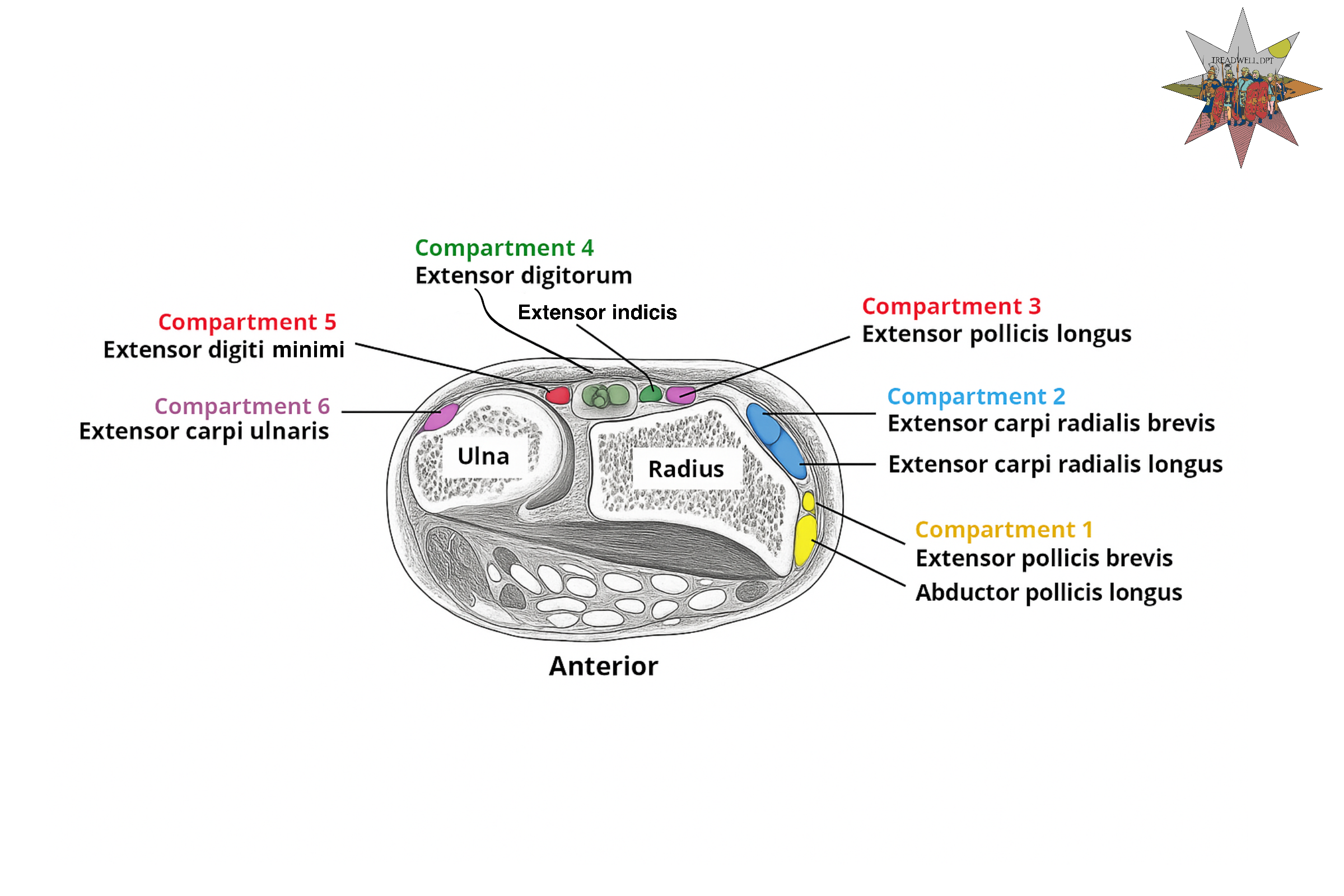
When you deadlift, row, or carry heavy loads — the 2nd dorsal compartment is doing serious behind-the-scenes work.
Function — What ECRL Actually Does
Functionally, ECRL is a wrist extensor, radial deviator, and dynamic stabilizer during gripping and upper-body loading.
Its major roles include:
𖤓 Wrist Extension
Works synergistically with ECRB and ED to lift the hand backward.
𖤓 Radial Deviation
ECRL helps move the hand toward the thumb side — think hammering, racket sports, backhand swings.
𖤓 Elbow Flexion Assist
Because it originates above the joint, ECRL contributes to elbow flexion in neutral or slight pronation.
𖤓 Grip Stability
During heavy gripping, the wrist wants to collapse into flexion.
ECRL fires isometrically to keep the wrist neutral — a major reason it develops in lifters.
Performance takeaway:
If you want a strong wrist, strong grip, and strong forearms… ECRL is one of the engines.
Innervation
Innervated by the Radial Nerve (C6–C7).
Important nerve detail:
ECRL receives its branch before the radial nerve dives into the supinator to become the Posterior Interosseous Nerve (PIN).
This means:
𖤓 ECRL often stays strong even in PIN compression syndromes
𖤓 It can help localize lesions along the radial nerve
𖤓 The BR reflex + ECRL strength can provide insight into C6 health
This is why ECRL is clinically useful in neuro screens.
Clinical & Research Insights
ECRL plays a huge role in both performance and rehab:
1. High-Force Grip = High ECRL Activation
Wrist extensors (including ECRL) fire hard during:
Deadlifts
Rows
Rock climbing
Racket sports
Farmer carries
Any situation where the wrist must resist flexion
If the wrist fights to stay neutral, ECRL is working.
2. ECRL vs ECRB — Subtle but Important Differences
ECRB = primary wrist extensor.
ECRL = the heavy-duty stabilizer.
ECRL ramps up more during:
𖤓 Heavy loads
𖤓 Radial deviation bias
𖤓 Pronation stabilization
𖤓 High-force eccentrics
This explains why lifters develop such a pronounced lateral forearm ridge.
3. Rehab Applications
ECRL is extremely sensitive to grip angle, wrist position, and forearm rotation.
Changing these variables changes its load dramatically:
Neutral grip → increases ECRL activation
Radial deviation → peaks demand
Pronation → increases stabilizing role
This makes ECRL ideal for:
𖤓 Graded loading
𖤓 Tendon rehab
𖤓 Forearm capacity building
𖤓 Elbow pain management
If someone’s forearm or lateral elbow breaks down under gripping tasks — ECRL should be on your radar.
Exercises That Target ECRL
Try these to load the muscle intentionally:
Radial deviation lifts
Rows with rope attachment & forearm pronated
Reverse curls
Hammer curls
Wrist extension isometrics
Farmer’s Walks
Video of Dr. Austin Treadwell, DPT completing cable rows with a rope attachment . Forearm neutral and the pronated to maximize extensor activation.
Work With Treadwell, DPT (Minneapolis & Virtual)
If you're dealing with:
Grip weakness
Wrist instability
Radial-sided forearm pain
Lateral elbow discomfort
Overuse injuries
Tendon irritation
Or you want to improve performance through better biomechanics, tendon loading, and grip strength training, you can work with me at:
https://www.TreadwellDPT.com/appointments
Men’s Health PT • Performance Coaching • Virtual Rehab
