
Extensor Carpi Radialis Brevis (ECRB): Anatomy, Function, and Why It Drives “Tennis Elbow”
ECRB is the quiet workhorse of the posterior forearm. If you lift, grip, type, throw, or train — this muscle is probably working right now. And if you’ve ever dealt with “tennis elbow” (lateral elbow pain), there’s a strong chance ECRB is the real culprit.
This page breaks down the ECRB anatomy, how it functions in real life (and in the gym), what nerve powers it, and why it’s so commonly involved in lateral elbow pain—plus practical, clinic-friendly takeaways.
Watch the Video
Extensor Carpi Radialis Brevis (ECRB) | Anatomy Breakdown – Muscle by Muscle

Quick Summary
𖤓 Location: Posterior forearm (radial side), deep to ECRL
𖤓 Main Role: Wrist extension & stability during gripping
𖤓 Clinical Relevance: Frequently involved in lateral epicondylalgia (“tennis elbow”)
Origin
The ECRB originates from the lateral epicondyle of the humerus via the common extensor tendon (the same general neighborhood as several other wrist/finger extensors).
Insertion
It inserts onto the base of the 3rd metacarpal (dorsal side), giving it a more central line of pull than ECRL.
Function
ECRB is a wrist extensor and assists with radial deviation, but its real functional superpower is stability.
Any time you grip — barbell, pull-up bar, bat, racket, heavy dumbbell — your finger flexors are generating big force. ECRB helps keep the wrist from collapsing into flexion, creating a stable platform so grip can actually be strong and controlled.
Real-world takeaway: If your wrist position fails, grip performance usually fails right after.
Innervation
ECRB is innervated by the deep branch of the radial nerve (with some known anatomical variability — some sources describe innervation near the transition into the posterior interosseous nerve). In plain terms: it’s a radial nerve muscle, and that matters clinically because irritation around the radial tunnel region can influence wrist extensor performance.
Clinical Relevance:
Why ECRB is the “Tennis Elbow” Muscle
When someone points to the outside of the elbow and says, “It hurts right here,” they’re describing the classic region of lateral epicondylalgia. ECRB attaches in that exact neighborhood—and it’s heavily loaded by everyday tasks like gripping, lifting with the wrist extended, and repetitive hand use.
Over time, that tendon can become sensitized and irritated, and many cases behave like a load tolerance problem: the tissue (and the system) isn’t prepared for the demands being placed on it.
Clinical/Gym Application
𖤓 Respect the tendon: rebuild tolerance gradually
𖤓 Train wrist extension control (not just “strength”)
𖤓 Improve grip endurance and wrist position under load
𖤓 Make changes to aggravating grips/positions temporarily so you can keep training while symptoms calm down
Rehab & Training Concepts
1) Wrist position is the cheat code
If you’re always gripping with the wrist slightly flexed or “breaking” under load, ECRB gets cooked. You want a wrist position that stays stable as the fingers generate force.
2) Slow, controlled loading beats random volume
For tendons and chronic irritation patterns, your best friend is typically progressive, controlled resistance — not endless high-rep junk.
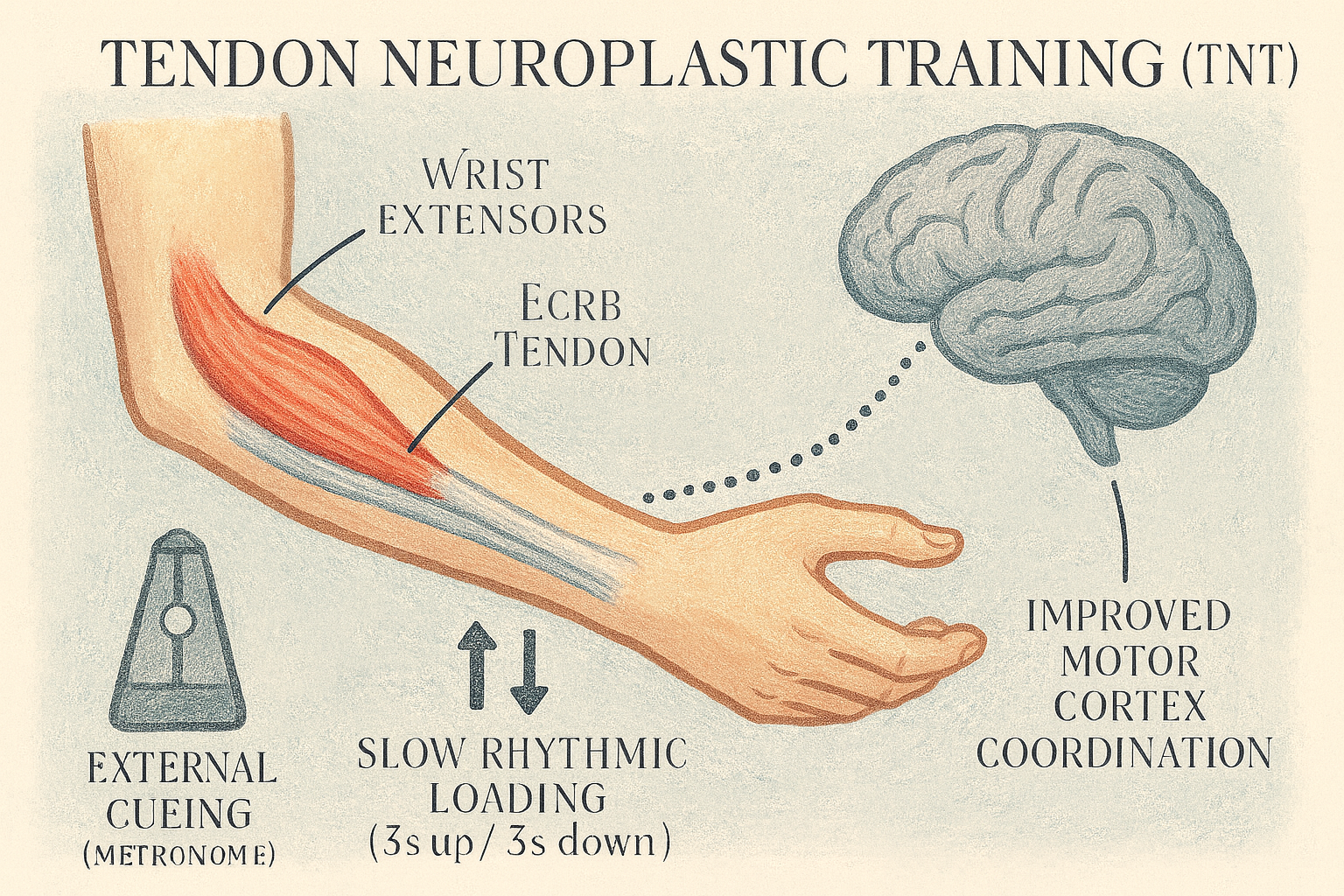
3) Tendon Neuroplastic Training (TNT) concept
A newer concept you’ll hear in tendon rehab is pairing slow isotonic loading with an external rhythm cue (think metronome pacing). The idea is: tendon rehab isn’t just tissue capacity — it’s also coordination and motor control. If the nervous system is guarding, timing is messy, and the movement is chaotic, symptoms often persist even when strength is “fine.”
Self-Assessment Ideas
If lateral elbow pain is your issue, ECRB often shows up with:
𖤓 Pain with resisted wrist extension
𖤓 Pain with resisted grip
𖤓 Tenderness near the lateral epicondyle/common extensor region
𖤓 Symptoms that worsen with repetitive hand use
Note: This isn’t a diagnosis — just common patterns. If symptoms persist, it’s worth getting assessed.
FAQs
𖤓 What does the ECRB do?
ECRB extends the wrist and helps stabilize wrist position during gripping tasks.
𖤓 Is ECRB the same as ECRL?
No — both extend the wrist, but ECRB inserts on the 3rd metacarpal and plays a major role in wrist stability and many cases of lateral elbow pain.
𖤓 Why is ECRB linked to tennis elbow?
Because its tendon attaches near the lateral epicondyle and gets heavily loaded by gripping and repetitive wrist/hand use.
𖤓 What exercises help ECRB irritation?
Generally, progressive wrist extensor loading and grip endurance work—performed with good wrist mechanics—tends to be more useful than random stretching alone.
𖤓 Should I stop lifting if I have tennis elbow?
Not always. Often you can modify grip, volume, and wrist position so you keep training while rebuilding tolerance.
