
Extensor Pollicis Brevis: Anatomy, Function & Thumb Extension Control
The Extensor Pollicis Brevis (EPB) is a posterior forearm muscle responsible for extending the thumb, particularly at the metacarpophalangeal (MCP) joint. It works closely with Abductor Pollicis Longus (APL) and is most often discussed in relation to radial-side wrist pain and De Quervain’s tenosynovitis.
This page covers the anatomy, function, innervation, and clinical relevance of EPB.
Watch the Video
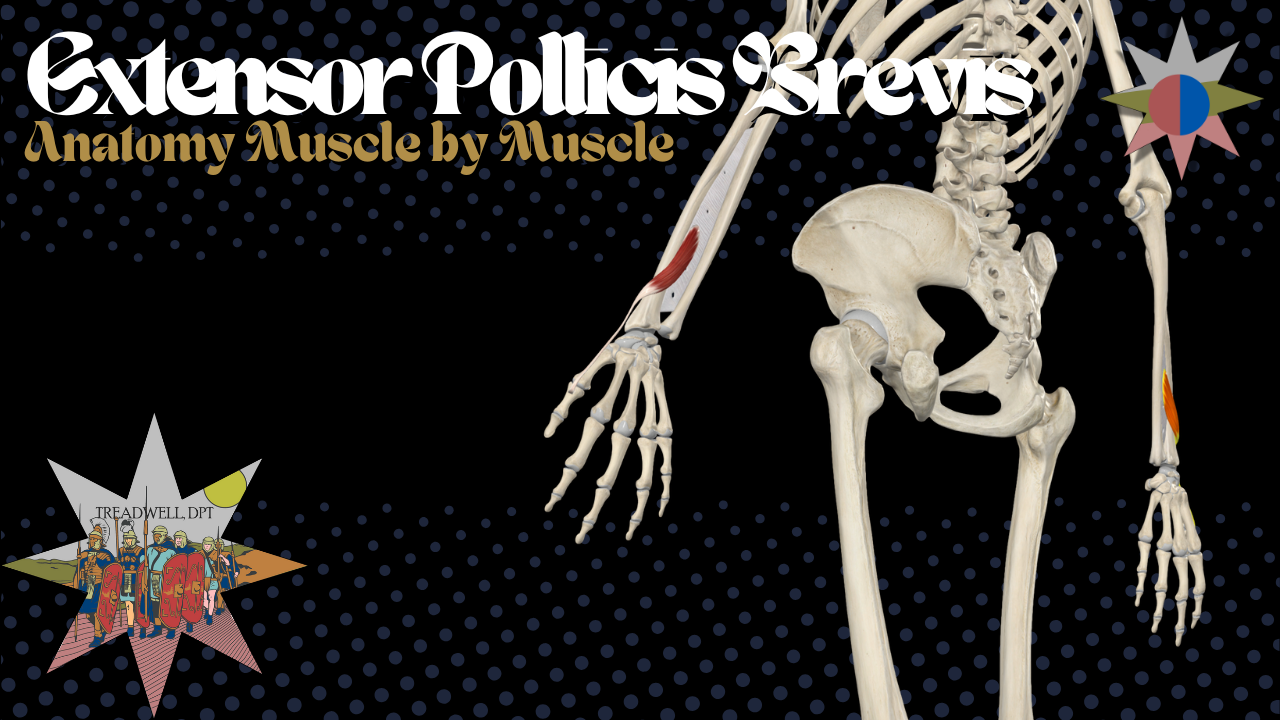
Quick Summary
Location: Deep posterior forearm, radial side
Primary Role: Thumb extension (MCP joint)
Secondary Role: Assists thumb CMC positioning
Innervation: Posterior interosseous nerve (radial nerve branch)
Anatomy at a Glance
Origin:
Posterior surface of the radius
Interosseous membrane
Pathway & Compartment:
EPB travels along the radial side of the posterior forearm and passes beneath the extensor retinaculum in the 1st dorsal compartment, sharing space with Abductor Pollicis Longus (APL).
Anatomical variation is common here — including septation within the compartment — which has clinical implications.
Insertion:
Base of the proximal phalanx of the thumb
What It Actually Does
Primary Function:
Extends the thumb at the MCP joint
Secondary Contributions:
Assists thumb extension at the CMC joint
Helps position the thumb during grip, release, and precision tasks
EPB’s role is more about control and positioning than force.
Why This Matters Clinically
EPB is frequently involved when thumb and wrist symptoms overlap.
✔️ Radial-side wrist pain
EPB is one of the two tendons implicated in De Quervain’s tenosynovitis, alongside APL.
✔️ Pain with thumb extension tasks
Texting, gripping, lifting, or repeated thumb motion can provoke symptoms.
✔️ Compartment sensitivity & variation
Septation within the 1st dorsal compartment can alter tendon mechanics and contribute to persistent symptoms.
EPB issues are rarely isolated — they’re usually part of a thumb load-management problem.
Practical Insight for Training & Rehab
Thumb extension with intent
Low-load, slow extension focusing on clean MCP motion.
Reduce excessive thumb tension
Over-gripping and constant thumb extension drive irritation.
Thumb-wrist coordination
EPB functions best when wrist position is controlled.
The priority is smooth motion and tolerance, not aggressive strengthening.
Quick FAQ
What does Extensor Pollicis Brevis do?
It extends the thumb primarily at the MCP joint.
How is EPB different from EPL?
EPB extends the MCP joint, while Extensor Pollicis Longus extends the IP joint.
Why is EPB linked to De Quervain’s?
Because it shares the tight first dorsal compartment with APL and is heavily loaded during repetitive thumb use.
Want Better Thumb & Wrist Function?
If thumb or wrist pain keeps coming back, anatomy helps clarify where control and load need to improve.
