
Abductor Pollicis Longus: Anatomy, Function & Radial Wrist Pain
The Abductor Pollicis Longus (APL) is a deep posterior forearm muscle that plays a major role in thumb positioning and radial-side wrist stability. While it’s often discussed in the context of De Quervain’s tenosynovitis, APL is more than just a pain generator — it’s a key contributor to functional thumb movement.
This page breaks down the anatomy, function, innervation, and clinical relevance of APL.
Watch the Video
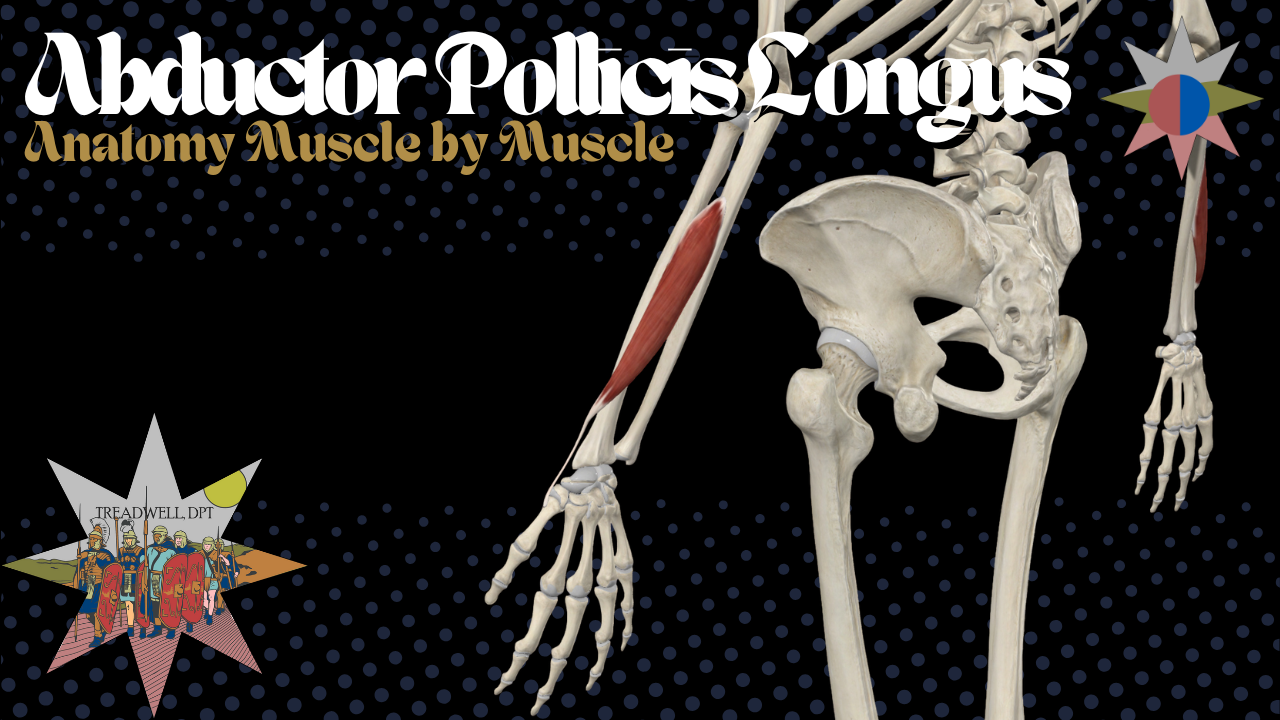
Quick Summary
Location: Deep posterior forearm, radial side
Primary Role: Thumb abduction at the CMC joint
Secondary Role: Assists wrist radial deviation
Innervation: Posterior interosseous nerve (radial nerve branch)
Anatomy at a Glance
Origin:
Posterior surface of the ulna
Posterior surface of the radius
Interosseous membrane
Pathway & Compartment:
APL travels distally along the radial side of the posterior forearm and passes beneath the extensor retinaculum in the 1st dorsal compartment, alongside Extensor Pollicis Brevis (EPB).
This tight compartment is clinically important and commonly implicated in radial wrist pain.
Insertion:
Base of the 1st metacarpal
Occasionally sends slips to the trapezium (anatomical variation is common)
What It Actually Does
Primary Function:
Abducts the thumb at the carpometacarpal (CMC) joint
Secondary Contributions:
Assists with wrist radial deviation
Helps position the thumb for grip, pinch, and precision tasks
APL doesn’t just move the thumb — it sets the thumb up to work efficiently with the rest of the hand.
Why This Matters Clinically
APL is one of the most frequently discussed thumb muscles in rehab settings.
✔️ Radial-side wrist pain
APL is commonly involved in De Quervain’s tenosynovitis, especially with repetitive thumb motion.
✔️ Pain with gripping or lifting
Particularly when the thumb is abducted under load (lifting a phone, kettlebell, or child).
✔️ Thumb control issues
Poor APL function can affect CMC joint mechanics and overload nearby tissues.
Because APL shares a tight compartment with EPB, irritation often reflects load tolerance issues, not just inflammation.
Practical Insight for Training & Rehab
Thumb abduction with control
Light resistance, slow range, emphasis on smooth motion.
CMC positioning before strength
Teaching proper thumb alignment reduces unnecessary stress.
Grip without over-abduction
Excessive thumb flare during lifting can irritate APL over time.
APL responds best to graded loading and movement quality, not aggressive strengthening.
Quick FAQ
What does Abductor Pollicis Longus do?
It abducts the thumb and helps stabilize the radial side of the wrist.
Why is APL linked to De Quervain’s?
Because it shares the tight first dorsal compartment with EPB and is heavily loaded during repetitive thumb use.
Is APL a wrist or thumb muscle?
Primarily a thumb muscle, with secondary effects at the wrist.
Want Better Thumb & Wrist Function?
Thumb pain is rarely random — it’s usually a loading and control issue. Anatomy helps clarify where to focus.
