
Supinator: Anatomy, Function & Why Forearm Rotation Matters
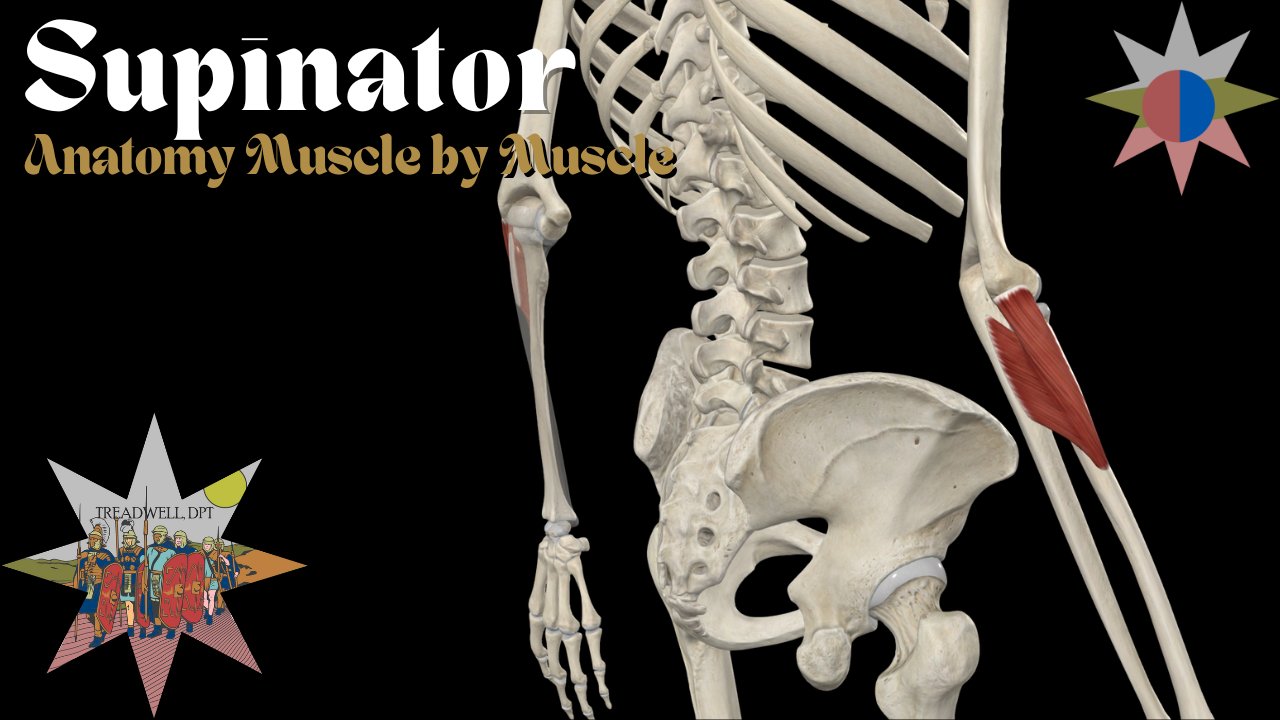
The Supinator is a deep posterior forearm muscle responsible for one simple but essential job: turning your palm up. It doesn’t get much attention because it’s quiet, subtle, and often overshadowed by the biceps — but when forearm rotation feels stiff, weak, or uncoordinated, Supinator is usually involved.
This page breaks down the anatomy, function, and clinical relevance of the Supinator muscle.
Watch the Video
Quick Summary
Location: Deep posterior forearm
Primary Role: Forearm supination
Most Active: Elbow extended
Innervation: Posterior interosseous nerve (radial nerve branch)
Anatomy at a Glance
Origin:
Lateral epicondyle of the humerus
Radial collateral ligament
Annular ligament
Supinator crest of the ulna
Pathway & Structure:
Supinator wraps around the proximal radius, forming a sling-like structure that rotates the radius laterally during supination.
The posterior interosseous nerve (PIN) passes directly through the muscle, making this region clinically important.
Insertion:
Lateral, posterior, and anterior surfaces of the proximal third of the radius
What It Actually Does
Primary Function:
Supinates the forearm (turns the palm upward)
Key Detail:
Supinator is most active when the elbow is extended
Biceps brachii dominates supination when the elbow is flexed
Think of it this way:
Supinator = control & endurance
Biceps = power
Why This Matters Clinically
Supinator becomes relevant when rotation feels limited or irritated — especially without obvious elbow pain.
✔️ Deep lateral elbow or proximal forearm discomfort
Supinator tension can mimic or coexist with lateral elbow symptoms.
✔️ Pain with repeated pronation–supination
Common in manual work, lifting, racquet sports, and keyboard-heavy tasks.
✔️ Posterior interosseous nerve sensitivity
Because PIN passes through Supinator, excessive tone or swelling can contribute to nerve irritation (motor symptoms without sensory loss).
Supinator problems are often misattributed to “tennis elbow” when the true issue is rotational control or load tolerance.
Practical Insight for Training & Rehab
Elbow-extended supination drills
Light resistance, slow control, full range.
Rotation before strength
Restore smooth pronation ↔ supination before adding heavy gripping or pulling.
Grip + rotation coordination
Supination combined with relaxed grip often exposes deficits faster than isolated strength tests.
This muscle responds best to low-load, high-control work, not brute force.
Quick FAQ
What does the Supinator do?
It turns your palm upward by rotating the radius.
Isn’t that the biceps’ job?
Both supinate — but Supinator works best with the elbow straight, while biceps dominates with the elbow bent.
Why does forearm rotation feel stiff without pain?
Often a motor control or endurance issue, not a true strength deficit.
Want Better Elbow & Forearm Control?
If rotation, grip, or elbow comfort feels limited — there’s usually a missing piece upstream or downstream. Anatomy helps point us in the right direction.
