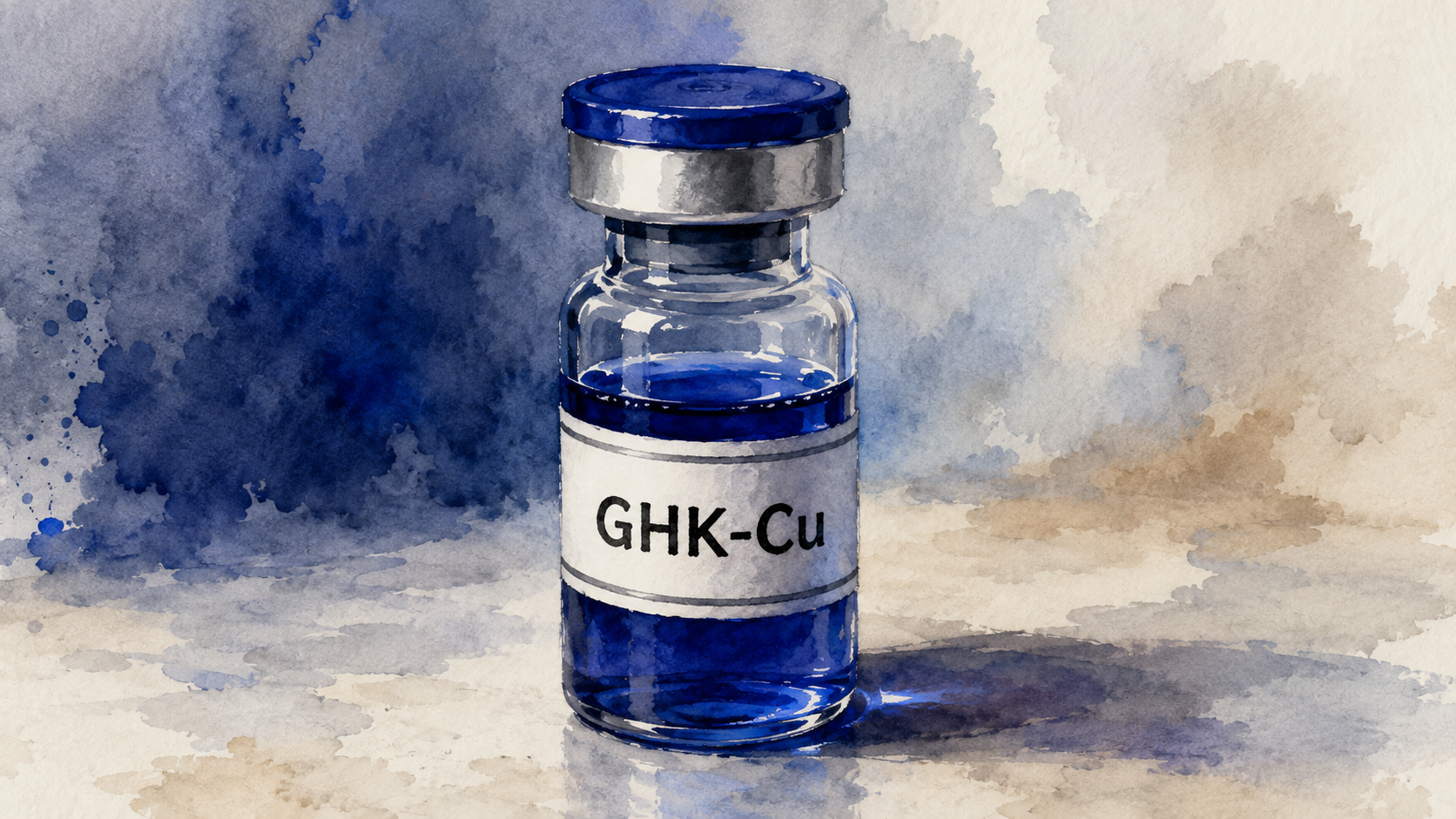
GHK-Cu Copper Peptide: Benefits, Research, Safety, Dosing, and What to Know
GHK-Cu is one of the most exciting peptides currently being explored for skin health, hair growth, collagen production, tissue repair, wound healing, and healthy aging.
Unlike many newer research peptides, GHK-Cu has been studied for decades.
It is a naturally occurring copper-binding peptide found in the human body, and research suggests that it may help activate repair signals involved in collagen production, skin remodeling, antioxidant defense, inflammation, blood-vessel formation, and cellular regeneration.
Interest in GHK-Cu has grown rapidly because its potential benefits extend across several highly desirable areas:
Firmer and healthier-looking skin
Improved collagen and elastin production
Reduced appearance of fine lines and wrinkles
Hair-follicle support
Faster tissue and wound repair
Reduced oxidative stress
Improved inflammatory balance
Support for broader healthy-aging pathways
This guide explores what GHK-Cu is, how it works, its potential benefits, commonly discussed dosing, topical versus injectable use, product quality, storage, and the current state of the research.
***Affiliate Disclosure: This page contains affiliate links to Real Peptides. Treadwell, DPT may earn a commission when purchases are made through these links, at no additional cost to you.***
***Disclaimer: This article is for educational and informational purposes only. GHK-Cu products sold for research are not intended to diagnose, treat, cure, or prevent disease. Information about experimental dosing reflects commonly discussed research and community protocols rather than individualized medical advice.***
What Is GHK-Cu?
GHK-Cu is a small copper-binding peptide made from three amino acids:
Glycine
Histidine
Lysine
GHK stands for glycyl-L-histidyl-L-lysine.
When GHK binds to a copper ion, it forms GHK-Cu, also known as copper tripeptide-1.
GHK occurs naturally in human plasma, saliva, and urine. Its concentration appears to be higher earlier in life and declines with age, which has helped drive interest in its potential role in tissue repair and healthy aging.
The peptide was originally identified during research examining why younger human tissue appeared to regenerate more effectively than older tissue.
Rather than functioning only as a copper-delivery molecule, GHK-Cu appears to act as a biological signal that may influence how cells respond to injury, oxidative stress, inflammation, and tissue breakdown.
How Does GHK-Cu Work?
GHK-Cu appears to interact with several repair and regeneration pathways.
Research suggests that it may influence:
Fibroblast activity
Collagen synthesis
Elastin production
Glycosaminoglycan production
Extracellular-matrix remodeling
Angiogenesis
Antioxidant enzymes
Inflammatory signaling
Wound closure
Hair-follicle activity
Gene expression
Fibroblasts are cells responsible for producing much of the collagen, elastin, and connective-tissue framework found throughout the body.
GHK-Cu has been shown in laboratory and preclinical research to support fibroblast function and increase the production of structural components involved in skin and tissue integrity.
This wide range of biological activity helps explain why GHK-Cu is being studied across skin care, hair health, wound healing, recovery, and longevity research.
Potential GHK-Cu Benefits
1. GHK-Cu for Skin Health and Anti-Aging
Skin health is the best-known and most researched use of GHK-Cu.
Topical copper-peptide products have been studied for their potential ability to improve:
Skin firmness
Skin elasticity
Fine lines
Wrinkles
Skin thickness
Texture
Clarity
Photodamage
Overall skin appearance
In controlled cosmetic research summarized in scientific reviews, GHK-Cu-containing creams were associated with increased collagen production and improvements in skin firmness, elasticity, fine lines, wrinkles, and visible signs of aging.
One frequently cited study found increased collagen production in approximately 70% of women treated with a GHK-Cu product, compared with 50% using vitamin C and 40% using retinoic acid.
Why GHK-Cu may help the skin
GHK-Cu may support skin quality by influencing:
Collagen synthesis
Elastin formation
Fibroblast activity
Skin-cell turnover
Antioxidant protection
Inflammatory balance
Extracellular-matrix repair
This combination makes GHK-Cu especially interesting for researchers exploring skin regeneration rather than temporary hydration alone.
GHK-Cu skin evidence rating
Promising human and preclinical evidence
Topical skin applications have the strongest human evidence currently associated with GHK-Cu.
2. GHK-Cu and Collagen Production
Collagen is the primary structural protein in skin, tendons, ligaments, cartilage, bone, fascia, and other connective tissues.
As collagen production declines with age, skin becomes thinner and less elastic, while connective tissues may become less resilient.
GHK-Cu has been associated with increased production of:
Collagen
Elastin
Glycosaminoglycans
Proteoglycans
It may also help regulate enzymes involved in breaking down and remodeling old or damaged collagen.
This is important because effective tissue remodeling requires more than simply producing new collagen.
The body must also:
Remove damaged or poorly organized tissue.
Produce new extracellular-matrix material.
Organize that material along appropriate lines of stress.
Develop adequate blood supply.
Integrate the repaired tissue into normal movement and function.
GHK-Cu appears to influence several portions of that process.
3. GHK-Cu for Wound Healing and Tissue Repair
GHK-Cu has been widely studied for wound healing and tissue regeneration.
Research suggests that it may support:
Faster wound closure
Fibroblast migration
Collagen deposition
Blood-vessel development
Reduced excessive inflammation
Improved tissue remodeling
Antioxidant protection at the injury site
A review of GHK-Cu research described regenerative effects involving skin, connective tissue, bone, liver, stomach lining, and other tissues.
In an animal burn model, GHK-Cu delivered through liposomes improved angiogenesis and shortened wound-healing time compared with free GHK-Cu.
These findings do not establish that every GHK-Cu product will produce the same result, but they help explain the growing scientific interest in the peptide.
GHK-Cu wound-healing evidence rating
Strong preclinical interest with promising translational potential
4. GHK-Cu for Hair Growth
GHK-Cu and related copper peptides have also attracted attention for their potential effects on hair follicles.
Researchers are exploring whether copper peptides may help:
Support dermal papilla cells
Encourage follicular activity
Prolong the growth phase
Reduce premature follicular-cell death
Improve scalp tissue quality
Support blood flow around hair follicles
Reduce inflammatory stress around the follicle
Dermal papilla cells sit at the base of the hair follicle and play a major role in regulating the hair-growth cycle.
Laboratory research involving the related copper peptide AHK-Cu found increased dermal-papilla-cell proliferation and reduced markers associated with apoptosis, or programmed cell death.
A human study involving a combination of GHK peptide and 5-aminolevulinic acid also reported potential value as a complementary intervention for male pattern hair loss. Because the study used a combination treatment, the contribution of GHK alone cannot be fully separated.
GHK-Cu hair-growth evidence rating
Promising laboratory evidence with early human interest
GHK-Cu remains a compelling research topic for hair and scalp health, although it has not yet been studied as extensively as established hair-loss interventions.
5. GHK-Cu and Inflammation
Inflammation is a necessary part of healing.
However, prolonged or excessive inflammation can interfere with tissue repair, collagen organization, skin health, and normal cellular function.
GHK-Cu appears to influence several inflammatory signaling pathways.
Research has explored its effects on:
NF-κB signaling
Interleukin-6
Tumor necrosis factor-alpha
Macrophage behavior
Reactive oxygen species
Cellular stress responses
Scientific reviews describe GHK-Cu as having notable anti-inflammatory and tissue-protective properties in laboratory and animal models.
This may be particularly relevant to researchers studying aging, chronic tissue stress, wound healing, and recovery.
6. GHK-Cu and Antioxidant Activity
Oxidative stress occurs when reactive molecules exceed the body’s antioxidant defenses.
Over time, oxidative stress may contribute to:
Collagen degradation
Cellular damage
Skin aging
Inflammatory signaling
Reduced tissue quality
Impaired recovery
GHK-Cu has demonstrated antioxidant activity in experimental models.
It may influence:
Superoxide dismutase activity
Glutathione-related pathways
Reactive oxygen species
Lipid-peroxidation products
Oxidative damage to proteins and cells
Researchers believe that these antioxidant effects may contribute to GHK-Cu’s broader regenerative and protective properties.
7. GHK-Cu and Healthy Aging
GHK-Cu is increasingly discussed as a healthy-aging or longevity peptide.
The most interesting aspect of this research is not simply that GHK-Cu may increase collagen.
Researchers have also examined how GHK may influence gene-expression patterns associated with:
Tissue repair
Inflammation
Antioxidant activity
Cellular regeneration
DNA repair
Nervous-system function
Extracellular-matrix maintenance
Reviews have proposed that GHK may help shift gene-expression patterns toward a younger or more regenerative profile.
Animal research has also explored potential cognitive and neurological effects, including inflammatory and epigenetic pathways involved in age-related cognitive decline.
This research remains early, but it is one of the reasons GHK-Cu continues to attract attention from longevity researchers.
GHK-Cu longevity evidence rating
Early and highly promising research interest
Long-term human studies are still needed to determine whether these molecular effects translate into meaningful changes in healthspan or lifespan.
Topical GHK-Cu Versus Injectable GHK-Cu
GHK-Cu is most commonly discussed in two forms:
Topical
Injectable research use
Topical GHK-Cu
Topical GHK-Cu is commonly found in:
Facial serums
Anti-aging creams
Scalp treatments
Hair products
Skin-repair formulations
Topical use has the most direct support from human cosmetic research.
It is primarily used to target the skin or scalp locally.
Injectable GHK-Cu
Injectable GHK-Cu is commonly discussed in peptide communities for broader systemic goals such as:
Skin improvement
Hair support
Tissue recovery
Collagen production
Anti-inflammatory effects
Whole-body healthy aging
The theoretical appeal is that systemic administration may expose a broader range of tissues to the peptide.
However, injectable GHK-Cu dosing has not yet been standardized through large controlled human trials.
The two routes should therefore be viewed as related but distinct research areas.
GHK-Cu Dosage
There is no universally established GHK-Cu dosage.
The amount used depends heavily on:
Route of administration
Product formulation
Research objective
Product concentration
Frequency
Duration
Target tissue
Common Experimental injectable GHK-Cu dosage
Injectable GHK-Cu protocols commonly circulated in peptide clinics and online research communities often use approximately 1–2 mg per day.
This range is experimental and has not been established through controlled human dose-ranging, pharmacokinetic, or efficacy trials.
Some protocols use daily administration, while others use less frequent schedules or structured cycles.
Because no single injectable regimen has been established as optimal, these numbers are best understood as commonly reported experimental practices rather than definitive clinical guidelines.
Topical GHK-Cu dosage
Topical GHK-Cu products vary significantly in concentration and formulation.
The effectiveness of a topical product depends on:
Concentration
Stability
Skin penetration
Delivery system
Additional ingredients
Frequency of application
Topical products should be evaluated according to their formulation rather than assuming that a higher concentration is always better.
How Long Is GHK-Cu Commonly Used?
Experimental GHK-Cu protocols often involve several weeks of consistent use rather than expecting immediate results.
Skin, hair, and connective-tissue remodeling are naturally slow processes.
Potential changes may require time because the body must:
Activate repair signaling
Produce new collagen or elastin
Remodel existing extracellular matrix
Support follicular growth cycles
Improve tissue organization
Many cosmetic studies have evaluated GHK-Cu-containing products over approximately 8–12 weeks. Reviews have reported improvements in several skin measures after twice-daily topical use for 12 weeks.
Hair growth may require even longer observation because hair follicles move through extended growth and resting cycles.
GHK-Cu Reconstitution
GHK-Cu research products are commonly sold in lyophilized, or freeze-dried, form.
Lyophilization helps improve stability during storage and transport.
Before laboratory use, the peptide may need to be reconstituted with an appropriate research diluent according to:
The manufacturer’s instructions
The desired final concentration
The research protocol
Laboratory handling procedures
Storage requirements
The amount of diluent determines the final concentration of the solution.
For example, the same 50 mg vial will produce very different concentrations depending on how much diluent is added.
Researchers should calculate concentration using:
Total peptide amount ÷ total liquid volume = peptide concentration
The appropriate concentration depends entirely on the intended research application.
GHK-Cu Storage
Proper storage is important for maintaining peptide stability.
Storage recommendations may vary based on whether the peptide is:
Lyophilized
Reconstituted
Intended for immediate use
Stored for a longer period
General storage considerations
GHK-Cu should generally be protected from:
Excessive heat
Direct light
Moisture
Repeated temperature changes
Contamination
Repeated freeze-thaw cycles
The supplier’s batch-specific handling and storage guidance should take priority over generic online recommendations.
GHK-Cu Side Effects and Considerations
GHK-Cu is generally described as well tolerated in topical cosmetic research.
Possible topical reactions may include:
Mild redness
Irritation
Itching
Sensitivity
Temporary dryness
Considerations involving injectable research products may include:
Injection-site irritation
Redness
Swelling
Contamination
Product impurities
Inaccurate concentration
Individual sensitivity
Unknown long-term systemic effects
Product quality and handling can meaningfully affect the research experience.
How to Choose a GHK-Cu Research Product
Not every GHK-Cu product is equivalent.
When evaluating a research supplier, look for the following.
Purity testing
High-performance liquid chromatography, or HPLC, is commonly used to evaluate peptide purity.
Identity confirmation
Mass spectrometry can help verify that the compound has the expected molecular identity.
Batch-specific documentation
Testing should match the specific lot being sold.
Endotoxin screening
Endotoxin testing is particularly relevant when evaluating peptide products intended for controlled laboratory research.
Transparent product quantity
A purity percentage and the total quantity in the vial are separate measurements.
Storage and handling information
The supplier should provide clear guidance for maintaining product stability.
GHK-Cu From Real Peptides
Real Peptides offers GHK-Cu Copper Peptide in 50 mg and 100 mg options for laboratory research.
According to the product page, the GHK-Cu is:
HPLC verified at 99% purity or greater
Endotoxin screened
Manufactured or finished in the United States
Supported by product testing documentation
Available in multiple vial sizes
Researchers can review the available product information, testing details, storage recommendations, and vial options directly through Real Peptides.
View GHK-Cu Copper Peptide at Real Peptides
Purchases made through this affiliate link may provide Treadwell, DPT with a commission at no additional cost to you.
Frequently Asked Questions
What does GHK-Cu stand for?
GHK stands for glycyl-L-histidyl-L-lysine.
GHK-Cu is formed when this three-amino-acid peptide binds to copper.
Is GHK-Cu a copper peptide?
Yes.
GHK-Cu is one of the best-known copper peptides and is also called copper tripeptide-1.
What are the main benefits of GHK-Cu?
GHK-Cu is primarily researched for potential benefits involving:
Skin rejuvenation
Collagen production
Hair growth
Wound healing
Tissue repair
Antioxidant activity
Inflammatory balance
Healthy aging
Does GHK-Cu help wrinkles?
Human cosmetic research summarized in scientific reviews suggests that GHK-Cu-containing topical products may improve skin firmness, elasticity, fine lines, wrinkles, and overall appearance.
Does GHK-Cu increase collagen?
Research suggests that GHK-Cu can increase fibroblast activity and influence collagen production and remodeling.
Does GHK-Cu grow hair?
Laboratory research involving copper peptides has shown potentially favorable effects on dermal papilla cells and hair-follicle activity.
Human research remains limited, but the early findings are promising.
Can GHK-Cu help with scars?
GHK-Cu’s potential effects on collagen remodeling, skin repair, fibroblasts, and inflammation have made it a popular research topic for scars and damaged skin.
Results may depend on the age, depth, and type of scar, as well as the formulation and delivery method.
Is GHK-Cu used topically or by injection?
Both forms are discussed.
Topical GHK-Cu is most commonly associated with skin and scalp applications.
Injectable GHK-Cu is discussed experimentally for broader systemic exposure, tissue repair, skin quality, hair health, and healthy aging.
What is a Common GHK-Cu dose?
Commonly circulated experimental injectable protocols often use approximately 1–2 mg per day.
This range has not been standardized through controlled human dosing studies.
How quickly does GHK-Cu work?
The timeline depends on the goal and route.
Skin changes may require several weeks of consistent use, while hair-related changes may take several months because of the natural hair-growth cycle.
Is GHK-Cu a steroid?
No.
GHK-Cu is a copper-binding peptide, not an anabolic steroid.
Is GHK-Cu a hormone?
No.
GHK-Cu is not considered a traditional hormone, although it may influence signaling pathways involved in repair and regeneration.
Can GHK-Cu be combined with other peptides?
GHK-Cu is commonly discussed alongside peptides such as:
BPC-157
TB-500
CJC-1295
Ipamorelin
These combinations are experimental, and the effects of using multiple peptides together have not been well established in controlled human research.
Does GHK-Cu affect testosterone?
GHK-Cu is not primarily known for directly increasing testosterone.
Its proposed benefits are more closely related to collagen, tissue repair, skin, hair, inflammation, and cellular signaling.
GHK-Cu Research Summary
Skin health
Evidence level: Promising human evidence
Topical GHK-Cu has been associated with improvements in firmness, elasticity, collagen production, wrinkles, and overall skin appearance.
Collagen production
Evidence level: Strong mechanistic evidence
GHK-Cu appears to influence fibroblasts, collagen synthesis, collagen remodeling, elastin, and extracellular-matrix activity.
Wound healing
Evidence level: Very Promising preclinical evidence
Research suggests potential benefits involving wound closure, blood-vessel formation, and tissue remodeling.
Hair growth
Evidence level: Early but promising
Copper peptides have demonstrated favorable effects on hair-follicle cells, with limited early human research.
Inflammation and oxidative stress
Evidence level: Strong preclinical interest
GHK-Cu appears to influence antioxidant and inflammatory pathways associated with tissue health and aging.
Healthy aging
Evidence level: Emerging
Research involving gene expression, cellular repair, inflammation, and tissue regeneration has made GHK-Cu an intriguing longevity research candidate.
Final Thoughts
GHK-Cu is one of the most compelling peptides in modern skin, hair, tissue-repair, and healthy-aging research.
Its appeal comes from the unusually broad range of biological processes it may influence.
GHK-Cu has been associated with:
Collagen production
Skin remodeling
Improved elasticity
Hair-follicle activity
Wound healing
Angiogenesis
Antioxidant defense
Inflammatory balance
Cellular regeneration
Healthy-aging pathways
Topical GHK-Cu currently has the strongest direct human support, particularly for skin quality and visible signs of aging.
Research into systemic use, hair growth, tissue recovery, and longevity remains earlier but continues to produce interesting findings.
As the science develops, GHK-Cu may become increasingly important in regenerative medicine, dermatology, hair restoration, recovery, and healthy-aging research.
Researchers interested in exploring available product specifications and testing documentation can view GHK-Cu Copper Peptide from Real Peptides here.