
Extensor Indicis – Full Anatomy Breakdown
If you’ve ever pointed your index finger or lifted it independently — you’ve used the
Extensor Indicis.
It’s a small muscle…
but it plays a big role in precision and control.
And clinically, it’s one of the reasons your index finger can move independently from the others.
Watch the Full Breakdown
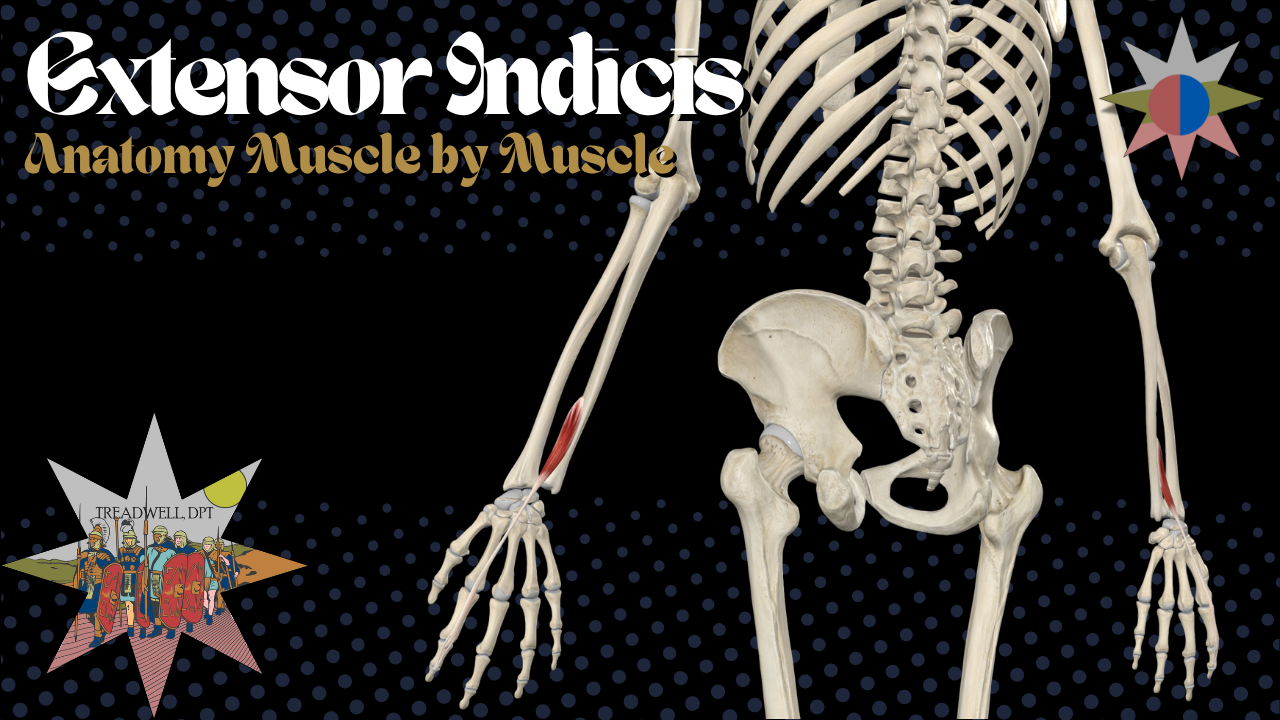
Origin
Posterior surface of the ulna
Interosseous membrane
Insertion
Extensor expansion of the index finger
Innervation
Posterior interosseous nerve (radial nerve branch)
Function
𖤓 Extends the index finger at the MCP joint
𖤓 Assists with IP joint extension via the extensor hood
𖤓 Enables independent extension of the index finger
Here’s the key — Unlike the other fingers, the index finger gets its own dedicated extensor.
That’s what allows for:
Pointing
Typing precision
Fine motor control
What Makes It Unique
The Extensor Digitorum extends all four fingers.
But the Extensor Indicis?
It specifically reinforces the index finger.
That gives the index finger:
More control
More independence
More precision
Translation:
This muscle is a fine motor upgrade, not just a mover.
Clinical Relevance
1. Loss of Independent Index Extension
If a patient can extend their fingers but struggles to isolate the index finger:
You’re thinking:
Extensor indicis dysfunction
Or posterior interosseous nerve involvement
2. Tendon Injury or Rupture
Less common than EPL issues — but still relevant with:
Trauma
Lacerations
Overuse
3. Radial Nerve / PIN Syndromes
Because this muscle is innervated by the posterior interosseous nerve:
Weakness here can be an early sign of:
Radial tunnel syndrome
PIN compression
Why This Matters for Training & Rehab
You don’t directly train extensor indicis — but you rely on it constantly.
Think:
Typing
Gripping with finger control
Sports requiring hand precision
Fine motor tasks
If this muscle isn’t doing its job:
You lose precision,
You compensate with other fingers,
& You reduce overall hand efficiency.
Simple Takeaway
The Extensor Indicis is what gives your index finger its independence.
Without it —
your hand loses a level of control that most people take for granted.
If you want the full breakdown — including movement, testing, and clinical application:
