
The fibularis brevis, also known as the peroneus brevis, is a muscle located within the lateral compartment of the lower leg.
It sits deep to the fibularis longus and follows a shorter, more direct path down the outside of the leg. Its tendon passes behind the lateral malleolus before inserting onto the base of the fifth metatarsal along the outer border of the foot.
The fibularis brevis is primarily responsible for ankle eversion and plays an important role in active lateral ankle stability. It is also clinically relevant in persistent posterolateral ankle pain, recurrent ankle instability, tendon subluxation, and fibularis brevis split tears that may be mistaken for a lingering ankle sprain.
Watch the Fibularis Brevis Anatomy Breakdown: https://youtu.be/kx8GkJCy2j8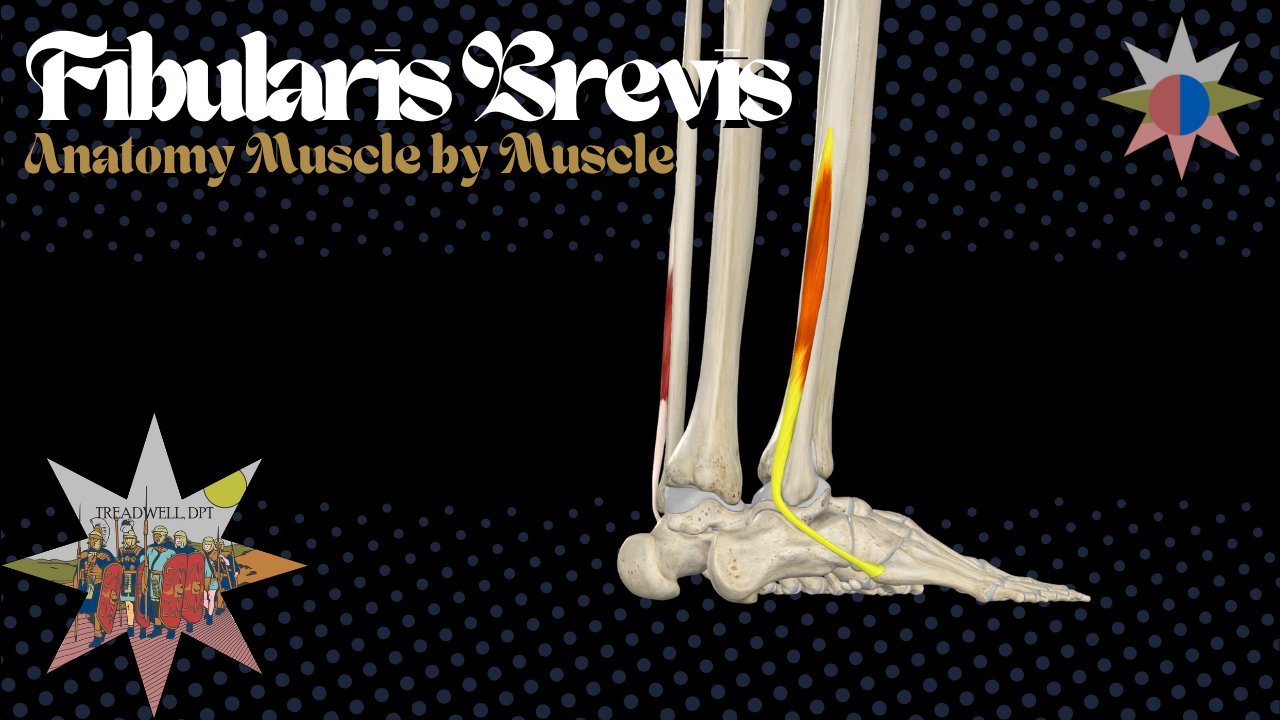
In this episode of Anatomy Breakdown – Muscle by Muscle, we cover:
Fibularis brevis origin and insertion
Its path behind the lateral malleolus
Ankle eversion and plantarflexion
Innervation and nerve roots
Active lateral ankle stability
Fibularis brevis versus fibularis longus
Fibularis tendon subluxation
Longitudinal split tears
Chronic posterolateral ankle pain
What Is the Fibularis Brevis?
The fibularis brevis is one of the two primary muscles within the lateral compartment of the lower leg.
The lateral compartment mainly contains:
Fibularis longus
Fibularis brevis
The fibularis longus is more superficial and begins higher along the fibula. The fibularis brevis sits deeper and originates farther down the lower leg.
The name helps describe the muscle:
Fibularis refers to the fibula.
Brevis means short.
Fibularis brevis therefore means the shorter muscle of the fibula.
Fibularis Brevis vs. Peroneus Brevis
Fibularis brevis and peroneus brevis are two names for the same muscle.
The term peroneus comes from an older anatomical naming convention, while fibularis refers directly to the fibula.
Both terms may still appear in:
Anatomy textbooks
Medical records
Imaging reports
Surgical notes
Rehabilitation plans
Modern anatomical terminology generally favors fibularis brevis, but many clinicians continue to use peroneus brevis.
Fibularis Brevis Origin
The fibularis brevis originates from the:
Distal two-thirds of the lateral fibula
This places its origin lower than that of the fibularis longus.
The muscle sits deep to the fibularis longus before its fibers converge into a tendon along the lower portion of the lateral leg.
Fibularis Brevis Insertion
The fibularis brevis inserts onto the:
Tuberosity at the base of the fifth metatarsal
The fifth metatarsal is the long bone that runs toward the little-toe side of the foot.
Its base forms a noticeable bony prominence along the outer border of the foot. This prominence can often be felt easily through the skin.
The fibularis brevis follows a relatively direct course:
Begins along the distal lateral fibula.
Travels down the lateral compartment.
Passes behind the lateral malleolus.
Continues forward along the lateral foot.
Inserts onto the base of the fifth metatarsal.
In simple terms:
Distal lateral fibula to the base of the fifth metatarsal
Fibularis Brevis and the Lateral Malleolus
The fibularis brevis tendon passes behind the:
Lateral malleolus
The fibularis longus tendon also travels through this region.
The fibularis brevis tendon generally sits closer to the fibula, while the fibularis longus tendon lies more posteriorly.
Both tendons are held in place by the:
Superior fibular retinaculum
This retinaculum helps prevent the tendons from moving excessively or snapping around the back of the lateral ankle.
If the retinaculum is damaged, the fibularis tendons may sublux or dislocate over the lateral malleolus.
Fibularis Brevis Function
The primary action of the fibularis brevis is:
Ankle eversion
Eversion turns the sole of the foot outward.
The muscle may also assist slightly with:
Ankle plantarflexion
Lateral foot control
Dynamic ankle stabilization
Because its tendon passes behind the ankle joint, it has a small plantarflexion moment. However, its primary functional role is eversion.
Fibularis Brevis and Ankle Eversion
Most lateral ankle sprains occur when the foot rapidly rolls inward into inversion.
The fibularis brevis helps oppose this movement by pulling the foot toward eversion.
It is part of the ankle’s active lateral support system.
The lateral ankle ligaments provide passive stability, including the:
Anterior talofibular ligament
Calcaneofibular ligament
Posterior talofibular ligament
The fibularis muscles provide active, contractile stability.
They can produce force, respond to movement, and help control the foot when the ankle begins rolling inward.
Fibularis Brevis vs. Fibularis Longus
The fibularis brevis and fibularis longus work together, but their anatomy gives them different mechanical roles.
Fibularis Longus
More superficial
Originates higher on the fibula
Passes underneath the foot
Inserts onto the first metatarsal and medial cuneiform
Helps stabilize the first ray
Supports the foot’s arches
Contributes to push-off mechanics
Fibularis Brevis
Deeper
Originates lower on the fibula
Remains along the lateral side of the foot
Inserts onto the fifth metatarsal
Provides more direct lateral-foot control
Acts as a strong ankle evertor
The fibularis longus has a wider influence across the foot, while the fibularis brevis has a more direct line of pull along the lateral ankle and foot.
Is Fibularis Brevis the Stronger Evertor?
The fibularis brevis may be more mechanically effective than the fibularis longus at producing pure foot eversion.
Cadaveric research comparing the two tendon mechanisms found that the fibularis brevis was more effective at:
Externally rotating the navicular
Moving the calcaneus toward valgus
Producing a direct eversion effect
This supports the idea that the fibularis brevis may be the more focused ankle evertor.
The fibularis longus remains important, but much of its function is distributed across first-ray control, arch support, and force transfer beneath the foot.
The fibularis brevis has a more direct relationship with the outer border of the foot.
Fibularis Brevis Innervation
The fibularis brevis is innervated by the:
Superficial fibular nerve
This nerve is also called the:
Superficial peroneal nerve
The associated nerve roots are primarily:
L5 and S1
The superficial fibular nerve supplies both major muscles of the lateral compartment:
Fibularis longus
Fibularis brevis
It also provides sensation to much of the lateral lower leg and the top of the foot.
Weak Ankle Eversion and Nerve Involvement
Weakness during ankle eversion does not automatically mean that the fibularis brevis muscle itself is weak or injured.
Possible causes include:
Fibularis brevis muscle weakness
Fibularis tendon pain
Superficial fibular nerve irritation
Common fibular nerve injury
L5 or S1 nerve-root involvement
Pain-related muscle inhibition
Reduced motor control following an ankle sprain
Sensory changes along the lateral lower leg or top of the foot may suggest involvement of the superficial fibular nerve.
Symptoms closer to the fibular head may raise concern for the common fibular nerve before it divides into its superficial and deep branches.
Fibularis Brevis and Lateral Ankle Stability
The fibularis brevis is a key component of active lateral ankle stability.
It contributes during:
Walking
Running
Cutting
Landing
Hopping
Single-leg balance
Uneven-surface activity
Rapid direction changes
When the foot begins rolling inward, the fibularis brevis must produce eversion force and help control the lateral border of the foot.
This response may not always prevent an ankle sprain, especially during a rapid or high-force injury. However, adequate strength, timing, and coordination can improve the ankle’s ability to manage unexpected movement.
Fibularis Brevis and Chronic Ankle Instability
Chronic ankle instability may develop after one or more lateral ankle sprains.
Possible symptoms include:
Recurrent ankle sprains
Repeated episodes of giving way
Reduced confidence on uneven ground
Difficulty cutting or landing
Poor single-leg balance
Ongoing lateral ankle pain
Reduced eversion strength
Altered neuromuscular control
Fibularis brevis weakness or poor activation may contribute to reduced control of inversion.
However, chronic ankle instability may also involve:
Ligament laxity
Impaired proprioception
Delayed muscular responses
Reduced ankle mobility
Balance deficits
Fear of reinjury
Fibularis tendon pathology
Fibularis Brevis Tendon Pain
The fibularis brevis tendon may become a source of pain along the back and outside of the ankle.
Possible symptoms include:
Pain behind the lateral malleolus
Posterolateral ankle tenderness
Pain during resisted eversion
Pain during walking or running
Swelling around the fibularis tendons
Snapping or clicking
Recurrent ankle instability
A feeling that the ankle gives way
These symptoms may initially be mistaken for a routine lateral ankle sprain.
Fibularis Brevis Split Tear
A fibularis brevis split tear is a longitudinal tear that develops along the length of the tendon.
Rather than tearing directly across, the tendon may split into separate portions.
These injuries may be associated with:
Repeated ankle sprains
Chronic tendon irritation
Fibularis tendon instability
Abnormal movement behind the lateral malleolus
Damage to the superior fibular retinaculum
Repetitive compression from the fibularis longus tendon
A split tear may produce persistent posterolateral ankle pain and recurrent instability.
Fibularis Brevis Tears and Lingering Ankle Pain
A fibularis brevis tendon injury can resemble an ankle sprain that never fully recovered.
Someone may report:
An ankle sprain several months earlier
Persistent pain behind the lateral malleolus
Ongoing swelling
Recurrent giving way
Snapping along the lateral ankle
Incomplete improvement with basic rehabilitation
Pain that feels different from the original ligament injury
In these cases, the fibularis brevis tendon should be considered alongside the lateral ankle ligaments.
Not every lingering ankle complaint is caused by an incompletely healed anterior talofibular ligament.
Can MRI Miss a Fibularis Brevis Split Tear?
Fibularis brevis split tears can be difficult to identify.
Research examining chronic lateral ankle pain found that fibularis brevis split ruptures were sometimes underreported on initial MRI interpretations.
This does not mean MRI is ineffective.
It means that:
Tendon tears may be subtle.
Imaging quality matters.
The interpreting clinician must specifically inspect the fibularis tendons.
Imaging findings must be compared with the clinical presentation.
Persistent symptoms may justify additional evaluation even when an initial imaging report does not identify a tendon tear.
Fibularis Tendon Subluxation
The fibularis brevis and longus tendons normally remain behind the lateral malleolus.
Damage to the superior fibular retinaculum can allow one or both tendons to move out of their normal groove.
Possible symptoms include:
Snapping behind the lateral ankle
A sensation of the tendon moving
Pain during ankle rotation
Swelling
Instability
Symptoms during resisted eversion
Pain during cutting or rapid direction changes
Tendon subluxation may occur during the same inversion or dorsiflexion mechanism that produces a lateral ankle injury.
Fibularis Brevis Rehabilitation
Early rehabilitation may include:
Isometric ankle eversion
Light banded eversion
Controlled ankle range of motion
Double-leg balance
Supported single-leg stance
Gradual walking progression
Calf strengthening
As symptoms improve, rehabilitation should become more functional.
Later-stage exercises may include:
Heavier resisted eversion
Single-leg calf raises
Lateral step-downs
Single-leg balance with perturbations
Lateral hopping
Diagonal hopping
Landing drills
Deceleration training
Cutting and direction changes
Sport-specific agility
Training the Fibularis Brevis as a Stabilizer
Basic banded eversion can help develop strength, but it does not recreate the speed or unpredictability of an ankle sprain.
Ankle injuries often occur when:
The foot lands on an uneven surface.
The athlete lands on another player’s foot.
The body moves faster than the ankle can respond.
The athlete cuts or pivots unexpectedly.
Fatigue reduces lower-extremity control.
The foot contacts the ground in a vulnerable position.
Later rehabilitation should therefore train:
Reaction speed
Single-leg control
Balance
Force absorption
Rapid eversion responses
Landing mechanics
Confidence under fatigue
Sport-specific movement
The fibularis brevis should be prepared to function as a real-time stabilizer rather than only as a slow, isolated evertor.
Fibularis Brevis Exercises
Exercises that may strengthen the fibularis brevis and lateral ankle system include:
Banded ankle eversion
Isometric eversion holds
Single-leg balance
Single-leg calf raises
Lateral step-downs
Lateral band walks
Lateral hops
Forward and diagonal hops
Balance with external perturbations
Uneven-surface walking
Agility drills
Cutting progressions
Exercise choice should reflect the person’s injury stage, tendon irritability, strength, balance, and activity demands.
Clinical Takeaway
The fibularis brevis is more than the shorter version of the fibularis longus.
It contributes to:
Ankle eversion
Resistance to excessive inversion
Direct control of the lateral foot
Dynamic lateral ankle stability
Balance and single-leg control
Cutting and landing mechanics
Its direct attachment to the base of the fifth metatarsal makes it a powerful and focused ankle evertor.
Its tendon is also an important consideration in people with chronic lateral ankle symptoms.
When someone continues to experience posterolateral pain, snapping, tenderness behind the lateral malleolus, recurrent giving way, or incomplete recovery after an ankle sprain, the fibularis brevis tendon deserves attention.
Do not only consider the ligaments. The tendon may also be part of the problem.
Frequently Asked Questions
What does the fibularis brevis do?
The fibularis brevis primarily everts the ankle. It also assists slightly with plantarflexion and contributes to active lateral ankle stability.
Where is the fibularis brevis located?
It is located within the lateral compartment of the lower leg, deep to the fibularis longus.
What is the origin of the fibularis brevis?
It originates from the distal two-thirds of the lateral fibula.
Where does the fibularis brevis insert?
It inserts onto the tuberosity at the base of the fifth metatarsal.
What nerve innervates the fibularis brevis?
It is innervated by the superficial fibular nerve, primarily from L5 and S1.
Is fibularis brevis the same as peroneus brevis?
Yes. Fibularis brevis and peroneus brevis are two names for the same muscle.
Does the fibularis brevis pass behind the ankle?
Yes. Its tendon passes behind the lateral malleolus with the fibularis longus tendon.
Is the fibularis brevis stronger than the fibularis longus?
The fibularis brevis may be more mechanically effective as a pure ankle evertor. The fibularis longus has broader roles involving first-ray control and arch support.
What is a fibularis brevis split tear?
It is a longitudinal tear in which the tendon separates into two portions rather than tearing directly across.
What does a fibularis brevis tendon injury feel like?
Possible symptoms include posterolateral ankle pain, tenderness behind the lateral malleolus, snapping, swelling, pain with eversion, and recurrent ankle instability.
Can a fibularis brevis tear feel like an ankle sprain?
Yes. Tendon injuries may occur with ankle sprains and can produce persistent symptoms that resemble a ligament injury that has not healed.
Can MRI miss a fibularis brevis tear?
Split tears can be subtle and may occasionally be underreported on an initial MRI interpretation. Imaging should be considered alongside the clinical examination.
What exercises strengthen the fibularis brevis?
Banded eversion, isometric eversion, single-leg balance, calf raises, lateral hopping, perturbation training, and cutting drills can strengthen the fibularis brevis as part of the lateral ankle system.
Continue Learning Anatomy
Continue exploring the origins, insertions, innervation, actions, and clinical relevance of the lower-leg muscles through Anatomy Breakdown – Muscle by Muscle.
Fibularis Longus Anatomy
Fibularis Tertius Anatomy
Continue with the third fibularis muscle and its role within the anterior compartment of the lower leg.
Subscribe to Treadwell, DPT



Fabric:100% cotton
Fabric Weight:10.3 oz/yd² (350 g/m²)
Fabric Thickness:Thick
To be loved is to be spotted.
The To Be Loved Tee is a clean, minimal graphic shirt built around one of the realest gym truths: sometimes love looks like someone standing close, paying attention, and making sure you don’t get crushed under the bar.
With bold front typography and a simple eyes-and-hands back graphic, this tee blends gym culture, quiet romance, and modern streetwear energy into an easy everyday piece. It’s soft, simple, and just mysterious enough to make people look twice.
Perfect for lifters, gym couples, spotter-for-life relationships, fitness lovers, and anyone who knows being seen is part of being loved.
Best for:
Gym lovers, lifters, fitness couples, workout partners, streetwear fans, romantic graphic tee lovers, and anyone who appreciates a clever gym-coded message.
NO REFUNDS OR EXCHANGES
