
Gemelli Anatomy: Superior Gemellus, Inferior Gemellus & Clinical Relevance
The superior gemellus and inferior gemellus are two small muscles located deep within the posterior hip. Together, they assist with hip external rotation, femoral head stabilization, and control of the hip during walking, running, cutting, pivoting, and single-leg movement.
Their name comes from the Latin word for twins or paired muscles.
Although they are usually discussed together, the superior and inferior gemelli are not identical. They have different origins and different nerve supplies, but both blend closely with the tendon of the obturator internus.
Together with the obturator internus, they form a functional unit sometimes called the triceps coxae.
Watch the Gemelli Anatomy Breakdown: https://youtu.be/PzRPa5zvQVw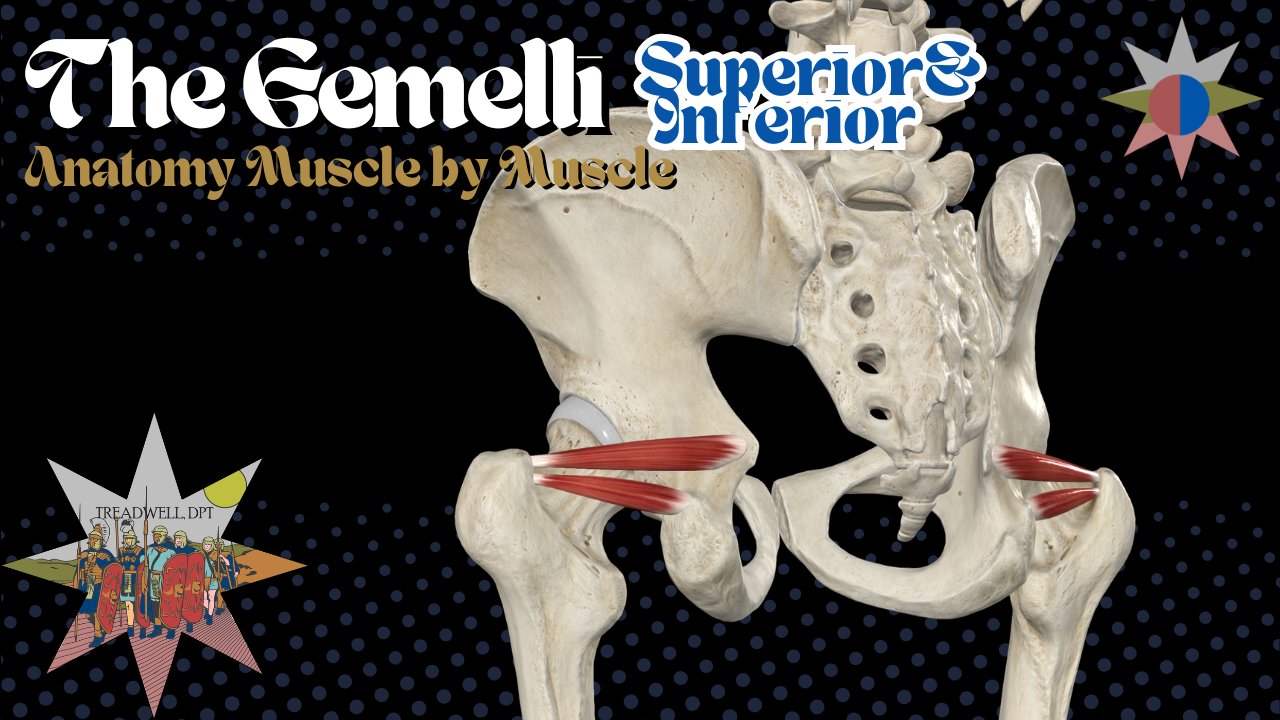
In this episode of Anatomy Breakdown – Muscle by Muscle, we cover:
Superior gemellus origin and insertion
Inferior gemellus origin and insertion
Their relationship with the obturator internus
Hip external rotation and stabilization
Innervation of each muscle
The triceps coxae
Deep gluteal syndrome
Gemelli-obturator syndrome
Their relationship with the sciatic nerve
What Are the Gemelli Muscles?
The gemelli are part of the deep six external rotators of the hip.
The deep six include:
Piriformis
Superior gemellus
Obturator internus
Inferior gemellus
Obturator externus
Quadratus femoris
From superior to inferior, the superior gemellus sits above the obturator internus tendon, while the inferior gemellus sits below it.
This creates a sandwich-like arrangement:
Superior gemellus
Obturator internus tendon
Inferior gemellus
The gemelli blend closely with the obturator internus tendon and function as part of the same deep posterior hip system.
What Is the Triceps Coxae?
The triceps coxae refers to the combined unit formed by:
Superior gemellus
Obturator internus
Inferior gemellus
These three muscles work together around the posterior hip.
The obturator internus tendon passes between the two gemelli, and all three converge toward the medial surface of the greater trochanter.
The triceps coxae contributes to:
Hip external rotation
Hip stabilization
Femoral head control
Posterior hip support
Fine control of rotation during movement
Superior Gemellus Origin
The superior gemellus originates from the:
External surface of the ischial spine
The ischial spine is a small bony projection located along the posterior pelvis.
From this origin, the superior gemellus travels laterally and blends with the obturator internus tendon.
Inferior Gemellus Origin
The inferior gemellus originates from the:
Upper portion of the ischial tuberosity
The ischial tuberosity is commonly called the sit bone because it bears pressure while sitting.
From there, the inferior gemellus travels laterally and joins the obturator internus tendon.
Gemelli Insertion
Both gemelli blend with the obturator internus tendon and insert onto the:
Medial surface of the greater trochanter
Region near the trochanteric fossa
In simple terms:
Superior gemellus: Ischial spine to greater trochanter
Inferior gemellus: Ischial tuberosity to greater trochanter
Both are closely integrated with the obturator internus tendon rather than functioning as completely independent muscles.
Gemelli Function
The gemelli are commonly described as:
Hip external rotators
When the hip is extended, they help rotate the femur outward.
However, their function changes with hip position.
With the Hip Extended
The gemelli assist with:
Hip external rotation
Posterior hip stability
Femoral head control
Rotational control
With the Hip Flexed
As the hip moves into flexion, the gemelli may contribute more to:
Hip abduction
Deep hip stabilization
Posterior femoral head control
Fine adjustment of hip position
The gemelli are not large prime movers. Their role is more closely associated with control, joint congruency, and stabilization.
Gemelli and Hip Stability
The gemelli help stabilize the femoral head inside the acetabulum.
They contribute during activities that require the hip to:
Rotate
Accept load
Change direction
Control single-leg position
Maintain stability under the pelvis
This makes them relevant during:
Walking
Running
Cutting
Pivoting
Single-leg stance
Squatting
Lunging
Direction changes in sports
The gemelli work with the obturator internus and other deep hip rotators to keep the femoral head organized while larger muscles create movement.
Superior Gemellus Innervation
The superior gemellus is innervated by the:
Nerve to obturator internus
The associated nerve roots are typically:
L5, S1, and S2
This nerve also supplies the obturator internus.
The superior gemellus and obturator internus are therefore connected:
Anatomically
Functionally
Neurologically
Inferior Gemellus Innervation
The inferior gemellus is innervated by the:
Nerve to quadratus femoris
The associated nerve roots are typically:
L4, L5, and S1
This is one of the key differences between the two gemelli.
A simple way to remember the pairing is:
Superior gemellus goes with obturator internus
Inferior gemellus goes with quadratus femoris
The gemelli may look and function like twins, but they do not share the same nerve supply.
Gemelli and the Sciatic Nerve
The gemelli are located within the deep gluteal region, close to the path of the sciatic nerve.
After the sciatic nerve passes beneath the piriformis, it travels through a crowded area containing:
Superior gemellus
Obturator internus tendon
Inferior gemellus
Quadratus femoris
Other deep gluteal tissues
This means posterior hip or sciatic symptoms should not always be attributed to the piriformis alone.
The sciatic nerve may be irritated or compressed by other structures within the deep gluteal space.
Deep Gluteal Syndrome
Deep gluteal syndrome refers to non-disc-related irritation or entrapment of the sciatic nerve within the deep gluteal region.
Possible symptoms may include:
Deep buttock pain
Posterior hip pain
Pain aggravated by sitting
Burning or tingling
Symptoms traveling down the posterior thigh
Pain reproduced by certain hip positions
The piriformis may be involved, but it is only one possible source.
Other structures that may contribute include:
Gemelli muscles
Obturator internus
Quadratus femoris
Fibrous bands
Proximal hamstring structures
Other tissues in the deep gluteal space
What Is Gemelli-Obturator Syndrome?
Gemelli-obturator syndrome describes possible sciatic nerve irritation around the combined gemelli and obturator internus musculotendinous complex.
This involves the full triceps coxae region:
Superior gemellus
Obturator internus tendon
Inferior gemellus
The sciatic nerve travels near and above this complex.
If the region becomes irritated, inflamed, compressed, or poorly tolerant of movement, the sciatic nerve may not glide normally.
Possible symptoms may include:
Deep buttock pain
Posterior hip pain
Sitting intolerance
Sciatica-like symptoms
Symptoms aggravated by hip rotation or flexion
This is not one of the most common diagnoses, but it is an important anatomical consideration when symptoms do not appear to come from the lumbar spine.
The Scissor-Like Effect
The sciatic nerve may travel between structures that create a dynamic, scissor-like relationship in the deep gluteal space.
The nerve passes beneath the piriformis and near the superior gemellus and obturator internus complex.
Certain hip positions may increase:
Compression around the nerve
Tension on the nerve
Pressure between deep hip structures
Irritation during nerve movement
This may help explain why some people experience worsening symptoms during aggressive deep hip stretching.
Should You Stretch the Gemelli?
People with deep hip tightness often immediately begin aggressive piriformis or hip-rotator stretching.
That approach may help some muscular presentations, but it may aggravate symptoms when the sciatic nerve is sensitive.
Positions involving hip:
Flexion
Adduction
Internal rotation
may lengthen the deep external rotators while also increasing tension or compression around the sciatic nerve.
A stretch may be too aggressive when it produces:
Burning
Tingling
Numbness
Shooting pain
Symptoms traveling down the leg
Increased pain after the stretch
A local pulling sensation is different from reproducing neurological symptoms.
Muscle Tightness vs. Nerve Sensitivity
A muscle tightness problem and a nerve sensitivity problem are not the same.
Muscle-related discomfort may feel:
Local
Achy
Stiff
Like a tolerable stretch
Better after controlled movement
Nerve-related symptoms may feel:
Burning
Tingling
Electric
Shooting
Traveling down the leg
Worse after aggressive stretching
When nerve symptoms are present, the better approach may involve:
Reducing compression
Modifying aggravating positions
Graded loading
Carefully dosed nerve mobility
Building hip strength
Improving movement control
Allowing the irritated system to settle
Gemelli Exercises
The gemelli are difficult to isolate because they work closely with the obturator internus and other hip rotators.
Exercises that may train the surrounding system include:
Resisted hip external rotation
Clamshells
Bridges
Monster walks
Lateral band walks
Split squats
Step-ups
Single-leg balance
Controlled lunges
Multidirectional stepping
Cutting and pivoting progressions
The goal is usually to improve deep hip control and load tolerance rather than isolate one small muscle perfectly.
Clinical Takeaway
The superior and inferior gemelli are small muscles with an important role in deep hip control.
They contribute to:
Hip external rotation
Hip abduction in flexion
Femoral head stabilization
Posterior hip control
Rotational coordination
Support of the obturator internus tendon
They also sit close to the sciatic nerve within the deep gluteal space.
When someone presents with deep buttock pain, sitting intolerance, posterior hip symptoms, or sciatica-like complaints that do not appear to come from the lumbar spine, the gemelli-obturator complex may deserve consideration.
The gemelli may not be the largest or most famous hip muscles, but their location gives them real clinical importance.
Frequently Asked Questions
What do the gemelli muscles do?
The superior and inferior gemelli externally rotate the hip when it is extended. In flexion, they may assist with hip abduction and deep joint stabilization.
Where are the gemelli muscles located?
They are located deep within the posterior hip. The superior gemellus sits above the obturator internus tendon, and the inferior gemellus sits below it.
What is the origin of the superior gemellus?
The superior gemellus originates from the external surface of the ischial spine.
What is the origin of the inferior gemellus?
The inferior gemellus originates from the upper portion of the ischial tuberosity.
Where do the gemelli insert?
Both gemelli blend with the obturator internus tendon and insert onto the medial surface of the greater trochanter near the trochanteric fossa.
What nerve innervates the superior gemellus?
The superior gemellus is innervated by the nerve to obturator internus, with contributions from L5, S1, and S2.
What nerve innervates the inferior gemellus?
The inferior gemellus is innervated by the nerve to quadratus femoris, with contributions from L4, L5, and S1.
What is the triceps coxae?
The triceps coxae is the combined unit formed by the superior gemellus, obturator internus, and inferior gemellus.
Are the gemelli related to the sciatic nerve?
Yes. They sit near the sciatic nerve within the deep gluteal space and may be relevant in some cases of non-disc-related sciatic nerve irritation.
What is gemelli-obturator syndrome?
It describes possible sciatic nerve irritation around the superior gemellus, obturator internus tendon, and inferior gemellus complex.
Can stretching the deep hip rotators make sciatica worse?
It can in some cases. Aggressive stretching may increase tension or compression around an already sensitive sciatic nerve.
Can you isolate the gemelli muscles?
Complete isolation is difficult because the gemelli work closely with the obturator internus and other deep hip rotators.
Continue Learning Anatomy
Continue exploring the origins, insertions, innervation, actions, and clinical relevance of the deep hip muscles through Anatomy Breakdown – Muscle by Muscle.
Obturator Internus Anatomy
Piriformis Anatomy
Gluteus Minimus Anatomy
Subscribe to Treadwell, DPT

Fabric: 100% cotton
Fabric Weight:10.3 oz/yd² (350 g/m²)
Fabric Thickness: Thick
For the rehab pros with championship-level hands.
The Soft Tissue Issues Tee brings pro wrestling energy to the physical therapy world with a loud, vintage-inspired graphic built for PTs, PTAs, massage therapists, athletic trainers, students, lifters, and anyone who knows soft tissue work can feel like a main event.
With a bold front logo and a full back graphic featuring championship rehab attitude, this shirt is made for people who live somewhere between the clinic, the gym, and ringside chaos.
Wear it to the clinic, the gym, class, or anywhere you want your PT humor to hit a little harder than the average anatomy tee.
Best for:
Physical therapists, PT students, rehab pros, massage therapists, athletic trainers, gym lovers, wrestling fans, and anyone with soft tissue issues.
NO REFUNDS/EXCHANGES
